

AI as Exposure Layer
Why This Wave Isn't Creating Weakness, It's Revealing It

The dominant narrative about AI and careers goes something like this:
AI is replacing jobs. AI is destabilizing careers. AI is making professionals obsolete. The wave is coming, and if you’re not ahead of it, you’re behind it.
I’ve heard versions of that sentence across every technology cycle I’ve lived through. And every time, it’s partially true and mostly misleading.
Yes, roles are changing. Yes, certain execution layers are compressing faster than people expected. Yes, there are real career consequences for professionals who aren’t paying attention.
But the framing is wrong, and wrong framing produces wrong responses.
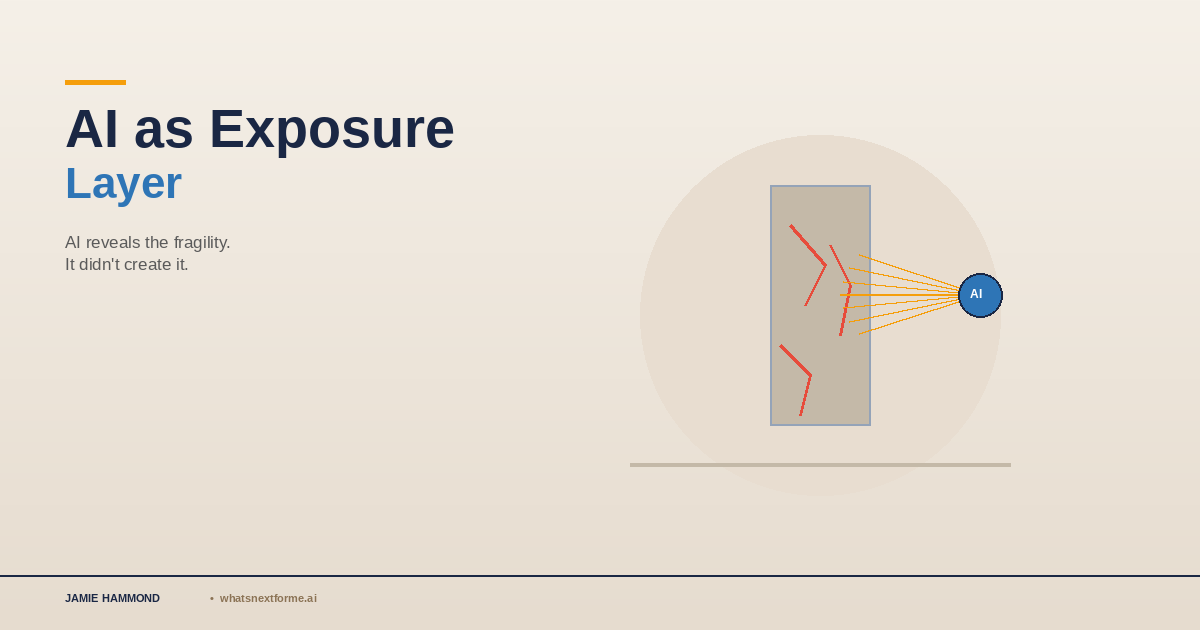
AI is not primarily a replacement force as much as it is an exposure layer.
What that means specifically is that AI is making visible what was already structurally fragile. It is surfacing the weakness that existed before it arrived. It is not creating the problem, despite how people sometimes feel: it is illuminating the problem.
That’s a harder truth than “AI is replacing you”, and it’s also a far more useful one. Because if AI is creating the fragility, the response is to wait it out or fight it. If AI is revealing fragility that was already there, the response is to do something about it…and to do so now, while there’s still time to build on solid ground.
The Illusion of Stability
Before we talk about what AI reveals, we need to talk about what was hiding.
For a long time, busyness functioned as a proxy for value. If you were visibly occupied (in meetings, managing processes, producing outputs, coordinating across functions) you were arguably necessary. And being necessary felt like being valuable. The distinction didn’t matter much when the workflow required a human at every step.
Manual execution made it harder to see when people had a lack of judgment. Process complexity made it harder to see when there was a lack of strategy. The impressiveness of a company’s headcount could make it harder to imagine that it wasn’t being efficient. People felt secure because they were load-bearing in the workflow, even when the workflow itself wasn’t producing much that required genuine thinking.
I saw this in consulting for years. Decks were built, frameworks were applied; deliverables were shipped. And a meaningful portion of the work (not all of it, but a meaningful portion) was sophisticated-looking output that didn’t require the kind of judgment it appeared to require. The value was in the production, but not always in the thinking behind it.
Fast forward to today: AI compresses the production. What now?
When output is automated, thinking becomes exposed.
And suddenly the question that workflow complexity was quietly answering on everyone’s behalf (like what do you actually know?) is back on the table, unanswered, in the middle of a very fast-moving moment.
The Four Fragilities AI Reveals
These are structural conditions that existed before AI and are now becoming impossible to ignore.
Execution Dependency. If the primary value you provided was moving information (summarizing, reformatting, routing, coordinating, producing) AI moves faster. Though not better, necessarily, but definitely faster. And in a world where speed was the competitive edge, that compression is real. The professionals most exposed here are people whose roles were built around execution throughput rather than interpretive judgment. Those are different things, and the market is now pricing them differently.
Tool Fluency Without Strategy. Knowing software is not the same as knowing leverage. I’ve watched this one for decades, where the person who becomes the most proficient operator of the current platform mistakes that proficiency for strategic value. When the platform changes, the proficiency resets, and if the strategic layer was never built underneath it, the reset is more than technical. AI is accelerating that cycle dramatically; fluency with AI tools is table stakes within eighteen months of any major release. What remains scarce is the judgment about when to use them, for what, and toward which actual business outcome.
Title-Based Authority. Authority built on hierarchy is structurally fragile in any environment where hierarchy is flattening, and AI is flattening it by compressing the middle layers that hierarchy used to manage. When a senior leader can access analysis directly that previously required three layers of staff to produce, the layers don’t disappear immediately. But their authority does, gradually, in the ways that are important. The professionals who built their influence on position rather than on genuine expertise and relationship are feeling this already, even if they don’t yet know exactly what changed.
Surface Expertise. If your knowledge was memorized rather than internalized (credentials acquired, frameworks learned, answers rehearsed) AI outpaces you. Not because your knowledge is wrong, but because the retrieval and synthesis of established knowledge is now fast and cheap. What AI cannot replicate is the application of judgment to novel, ambiguous, high-stakes situations. The kind of knowing that comes from having been wrong in consequential ways and recalibrating. That’s not in AI training data, but it is in your own career scar tissue.
The Repeat Beginner Response
There are two ways to respond to exposure.
The first is the reaction: panic, denial, defensive posturing, performative skepticism about AI; or the opposite, anxious overcorrection that treats every new tool as the solution to a problem that is fundamentally about thinking.
The second is the Repeat Beginner response, which starts with honesty.
Audit your structural value: what do you actually know, in the durable sense? Where is your judgment genuinely differentiated from that of others? Where, if you’re honest, have you been relying on workflow complexity to carry weight that your thinking should have been carrying?
Identify what the exposure is showing you; it will be useful information.
Then strengthen the authority layer. Build the things AI doesn’t compress: pattern recognition, interpretive judgment, the ability to navigate organizational complexity, the credibility that comes from being right about hard things over time.
And integrate AI as an amplifier of that foundation instead of a substitute for it.
Exposure is feedback; and feedback taken with humility and listened to is one of the most valuable inputs a professional can get. Especially feedback that arrives before the consequences become irreversible (typically, and situationally, as you can see if you read my book).
What the Shift Actually Looked Like
When I left consulting and started building independently, I had a version of this reckoning myself.
The institutional infrastructure I’d operated inside for years (the brand, the methodology, the delivery machine, the client relationships that came with the firm’s reputation) had been carrying more weight than I’d consciously acknowledged. When it was gone, I had to find out quickly what was actually mine. What clients would pay for because of what I knew and how I thought, not because of what letterhead was at the top of the proposal.
That exposure was uncomfortable, but it was also the most clarifying professional experience I’ve had. It forced a genuine audit of myself: what was actually portable here, and what was dependent on the container?
AI is doing a version of that audit for professionals everywhere, whether they asked for it or not. The container is being stress-tested. What survives that test is what was actually durable.
AI isn’t the villain of this story like some people think; it’s the diagnostic.
The professionals who thrive in this era will not be the ones who are most fluent with the tools. Fluency is temporary and widely distributed. They will be the ones who are most structurally sound, whose value was built on judgment, pattern recognition, and genuine expertise rather than on execution throughput and workflow necessity.
The exposure is the opportunity. If you know where the fragility is, you can do something about it.
Next in this series: Ego Detachment Speed — the final discipline you have to have, and the hardest one. The faster you can release who you were, the faster you can become who the moment requires.