

The Repeat Beginner
Why Identity Adaptability Is the Real Advantage in the AI Era

I’ve lived through multiple waves of professional panic.
The early internet, when “what is that?” was a real question people asked in serious business meetings. The dot-com collapse. 9/11. The 2008 financial crisis. The rise of mobile. The acceleration of the cloud. And now AI, moving faster than any of the others and somehow generating even more noise.
Each time, the language changes, and each time, the headlines insist this one is different. Each time, some combination of executives, consultants, and conference speakers assures everyone that everything is about to change forever.
And each time, the same underlying question surfaces for real professionals trying to navigate real careers:
Am I still relevant?
I’ve asked it myself. More than once. I was asking it the morning I got “transitioned out” of a major consulting firm, a firm whose name looked good on LinkedIn, whose work I’d given everything to, and which let me go with the kind of clean corporate efficiency that makes you wonder if you ever really mattered at all.
That question, what’s next for me? eventually became a book. But before it became a book, it became a reckoning with something I hadn’t fully named yet.
What’s different now isn’t disruption. We’ve had disruption. What’s different now is the speed at which professional identity expires.
Roles turn over faster. Industries reorganize quicker. Tools compress what used to take years of execution into months, sometimes weeks. What used to feel like a once-in-a-career reinvention now happens multiple times per decade. Maybe you’ve already felt it, the strange vertigo of realizing that the thing you spent years becoming good at is being quietly automated, restructured, or simply made irrelevant by a market that didn’t ask your permission.
The professionals who are thriving in this environment are not the most credentialed, or even the most technically sophisticated. They are the most structurally adaptable.
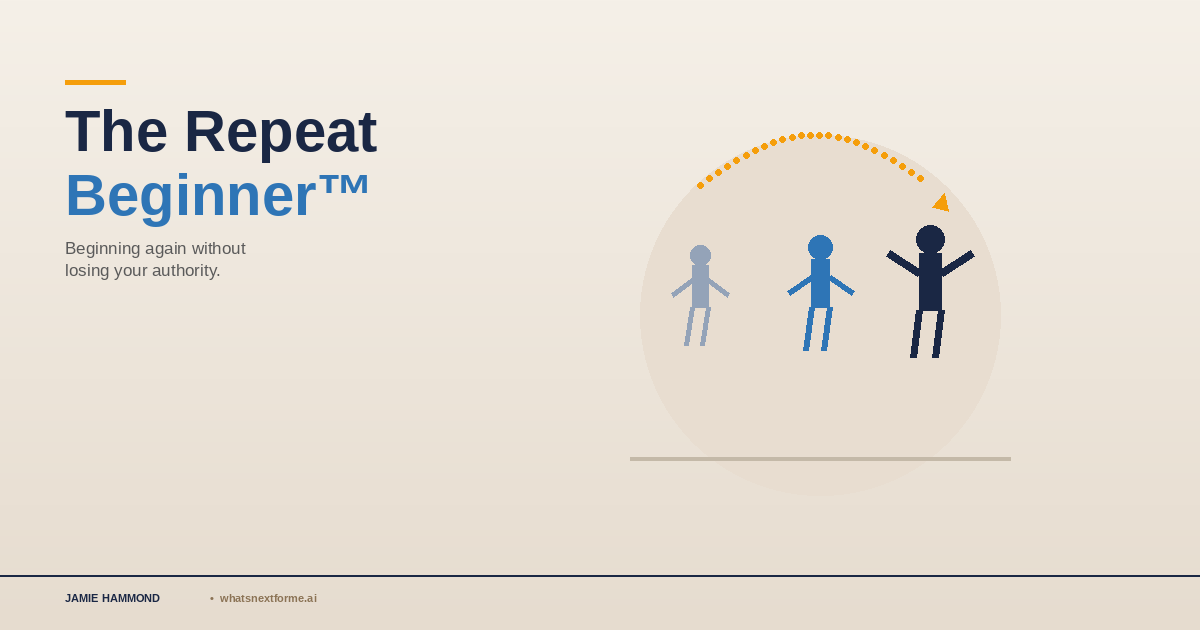
I’ve started calling this discipline The Repeat Beginner™.
A Repeat Beginner is not inexperienced: that’s the first thing to get straight. Inexperience and adaptability are not the same thing, and they get confused constantly.
A Repeat Beginner is seasoned. They’ve built things and watched those things become obsolete. They’ve held titles and had those titles restructured away. They’ve been the expert in the room and then found themselves, a few years later, having to learn everything again.
And instead of treating that cycle as failure, they’ve learned to treat it as the actual job.
The Repeat Beginner understands something subtle but powerful: relevance is rented, and the rent comes due every technological cycle. Expertise must evolve, and identity must be flexible. Authority must travel across the full arc of a career that now spans multiple technological generations.
And this has to happen repeatedly.
Over 25 years of riding these waves, I’ve watched two kinds of professionals respond to disruption.
The first cling to titles. They defend past expertise, and resist reframing. They double down on the identity that made them successful, sometimes so hard that they can’t see how much the ground has shifted beneath it. They’re not incapable, but they are very attached.
The second detach faster: they reinterpret their experience for new contexts; they rebuild around new constraints. And they begin again, but they bring their memory with them.
The difference isn’t intelligence or credentials. It’s not even experience, exactly. We might call it ego detachment speed.
The faster you can release who you were, the faster you can become who the moment requires. That sounds simple, but take it from me, it is not simple. I’ve watched brilliant people stay stuck for years because they couldn’t put down the identity that used to serve them, and I’ve watched people with half the raw talent move quickly because they were willing to be a beginner again.
Over time, I’ve come to see that Repeat Beginners practice five specific disciplines. These are things they do repeatedly and deliberately, even when it’s uncomfortable.
Identity Optionality. Don’t over-attach to a role. Build portable value: skills, ways of thinking, ways of working that can travel beyond any one employer or industry or era. Titles are containers. Containers become obsolete. Your value doesn’t have to go with them.
Reframing Before Reskilling. Everyone’s default response to feeling behind is to chase the new tool. Take the course. Stack the certification. And sometimes that’s right, but Repeat Beginners do something counterintuitive first: they audit what they already know. They ask where their existing pattern recognition actually applies in the new landscape. Most of the time, the answer is more than they expected. The reframe comes before the reskill. This is more efficient, and it’s also more honest.
Pattern Authority. What nobody talks about enough in the AI era is that experience across cycles compounds. The ability to recognize when a vendor is selling vaporware. To know the difference between a technology that will actually change behavior and one that will fade after the pilot. To feel in your bones when an organization is moving at technology velocity instead of human velocity. AI doesn’t produce that; you build it up yourself. And instead of “starting again” meaning starting from zero, it means starting from pattern recognition, with your memories intact.
AI as Exposure Layer. This one makes people uncomfortable, so I’ll say it directly: AI is not creating weak professional architecture as much as it is revealing it. If your role is collapsing because a tool can now automate most of your output, that fragility existed before the tool arrived, and the tool just brought it to the surface. Repeat Beginners use that clarity as a gift. They ask: what does AI make better when combined with what I actually know? That’s the right question. It is a fundamentally different posture than either panic or denial.
Ego Detachment Speed. Back to this one, because it’s probably the hardest. The fastest predictor of adaptability I’ve observed in 25 years is not intelligence, not credentials, not industry connections: it’s how quickly someone can detach from a former identity without losing their sense of authority in the process. These are not the same thing; you can let go of who you were and still trust yourself. You can be new to a space and still be someone worth listening to. It takes discipline to hold both of those things at once.
Here’s what mastery looks like now: it is not permanence.
The 10,000-hour endpoint that grants you a title you hold for the rest of your career… that model served a slower world. In the world we’re in now, mastery is disciplined reinvention without losing your authority. The reinvention is real, but you don’t have to zero-out your authority, too.
I’m navigating AI right now, at 50, with the same patterns I’ve seen repeat since dial-up internet. The technologies are different, but the underlying human dynamics are remarkably consistent. And every time I’ve been willing to begin again, to sit in the discomfort of not knowing yet what to do while trusting the weight of everything I’ve already learned, it has worked out better than clinging to past technology would have.
The question is not whether you will need to begin again. You will; that’s already settled.
The question is whether you can do it without destabilizing your identity in the process. Whether you can hold “I don’t know this yet” without collapsing into “I’m not enough.” Whether the title going away means the authority goes with it, or whether you’ve built something more portable than that.
That’s the Repeat Beginner.
And in an era where tools evolve faster than job descriptions, it may be the only durable advantage left.
You can do it.
This is the first in a series unpacking each of the five Repeat Beginner disciplines in depth. If you saw yourself in any of this, share it with someone in the middle of a reinvention right now. They probably need the reframe.