

The Judgment Economy
When Execution Gets Automated, There’s Still A Lot Left Over

For most of modern economic history, the most valuable thing a professional could sell was a combination of knowledge and execution. You knew how to do something, and you could do it reliably, at scale, on deadline.
That combination drove decades of career ladders. You built expertise and accumulated credentials; you demonstrated that you could execute. You got promoted, or you got hired, or you got retained. The model was coherent and relatively stable.
That model is changing faster than most people are prepared for. And the professionals who understand what is replacing it, and why, are going to have a significant advantage over the ones who don’t.
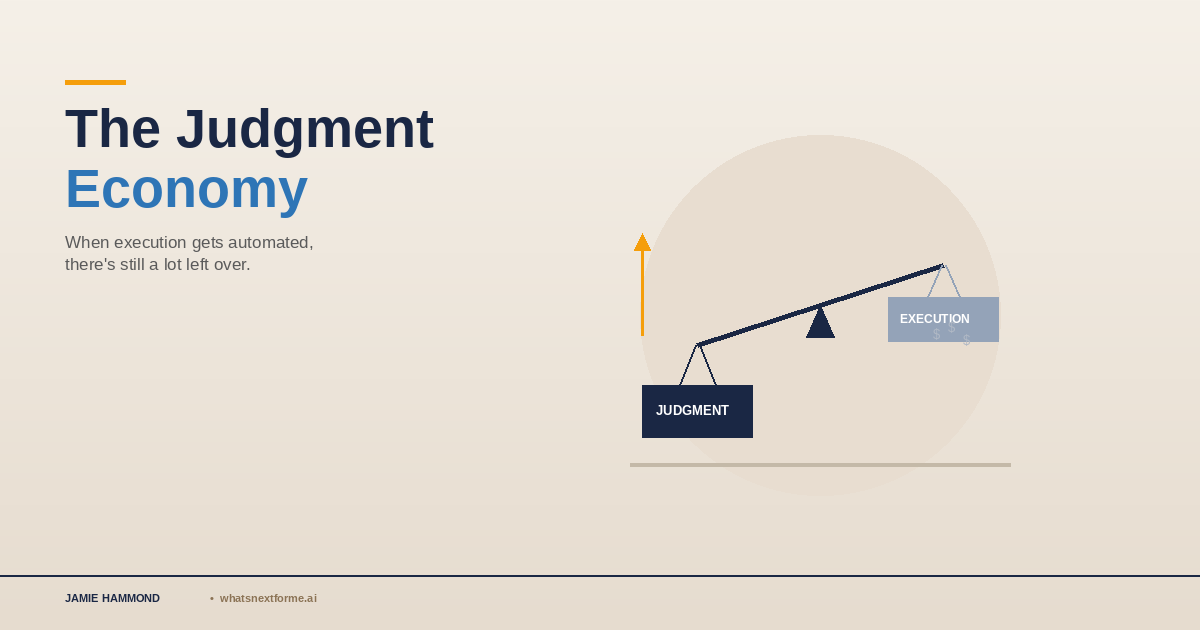
The thesis is this: we’re entering what I call the Judgment Economy. An era in which execution is cheap, readily available, and increasingly automated, and in which the scarcest, most financially valuable professional asset is calibrated judgment, the capacity to know what to do, when to do it, why it matters, and what will go wrong.
This follows directly from what AI is doing to the economics of professional work.
The Commodity Inversion
I’ve watched commoditization happen to every technology wave I’ve been a part of. The internet made information free; eCommerce made buying and distribution accessible to anyone; the cloud made computing infrastructure a utility. Each wave commoditized something that used to be scarce.
AI is commoditizing execution.
Now, not all execution. Not the execution that requires physical presence, genuine relationship, or real-world navigation, but the execution in documents, data, analysis, synthesis, writing, and structured problem-solving, which is the execution that defines most knowledge work, is being compressed at a rate that would have been unimaginable five years ago.
When execution gets commoditized, scarcity moves upstream.
Upstream from execution is judgment: the capacity to determine what the analysis should actually be asking, and what the document should actually be saying. What the strategic question underneath the tactical noise actually is; what the client needs that they haven’t articulated yet; what will fail in the implementation before anyone builds it.
Judgment is not a synonym for experience, though experience is one way to build it. Judgment is the distillation of pattern recognition, domain exposure, calibrated skepticism, and the willingness to be wrong enough times to know what right actually feels like.
You cannot download it or generate it with a prompt, and you cannot hire for it with a credential.
The Three Properties of Judgment
I’ll try to be precise here, because vague references to “judgment” as a career asset tend to produce vague career strategies. Judgment that matters in the current economy has three specific properties.
It is calibrated to failure. The most valuable judgment I’ve developed over 25 years was built from watching things fail: watching the enterprise platform that looked inevitable become shelfware; watching the transformation roadmap that every executive loved get quietly buried two years later; watching the client who swore they were committed to change protect the very structure that was preventing it. I know where implementations fail because I’ve watched them fail. That failure-calibrated pattern recognition is not something you can build without exposure to the failures themselves.
It is independent of the current consensus. Judgment that just follows consensus is only that: following. The kind of judgment that has real market value is the kind that can tell you what the room is getting wrong, even when the room is full of smart people who are very confident. This requires enough exposure to watch confident rooms be wrong consistently enough to trust your own read over theirs when the data supports it.
It is translatable across contexts. The most durable professional judgment is not domain-specific, but is instead structural. The same patterns that play out in enterprise software implementations play out in digital transformation projects, in go-to-market strategies, in product launches, and so on. The organizations are different and the technology is different, but the underlying human dynamics are identical. Professionals who recognize this have judgment that builds on itself across every new context they enter.
What This Means for How You Price Yourself
The Judgment Economy has a practical implication that most senior professionals haven’t fully internalized: if judgment is the scarce asset, then the value you sell is not your time. It is your read of a situation.
This matters because most senior professionals still price themselves as executors. They think in terms of hours, deliverables, and projects, and compete on throughput. And in a world where AI agents can produce throughput at a fraction of the cost, that is an increasingly losing position.
The professionals who are thriving right now, the ones commanding premium rates in advisory, fractional, and consulting contexts, are the ones who have made the shift. They are selling their read on the situation, their ability to identify the right question before anyone else has framed it, and their track record of being right about things that mattered.
That’s a completely different economic proposition, and it’s also one that AI cannot replicate.
The Window Is Open, But It’s Not Open Forever
Here’s a part I want to emphasize: the window for this positioning advantage is real, but it is not permanent. What’s happening right now is a transitional period in which execution has been automated but the frameworks for pricing and deploying judgment haven’t fully caught up. The professionals who recognize this transition early and position themselves for the Judgment Economy will capture the premium that comes with being ahead of the market.
The ones who wait, who keep positioning themselves as executors, who keep competing on throughput, who keep waiting for someone to hand them a new playbook, will find themselves in a more crowded, more commoditized market than the one they’re already navigating.
The Judgment Economy is the way things work now.
The question is less whether to position for it, and more whether you’ll do it before the window closes.