

Ego Detachment Speed
The Hidden Variable Behind Career Reinvention

Careers don’t tend to collapse dramatically. The more common thing is that they just stall.
There is no single catastrophic moment or obvious inflection point. Just a gradual narrowing of new opportunities, less visibility in the rooms that matter, and perhaps a growing sense that the ground has shifted and you’re still standing where you were when it moved.
Most of the time, it’s not because the professional isn’t capable. It’s not intelligence or credentials. It’s just that they can’t let go of who they used to be.
I’ve watched this pattern across 25 years of technology cycles, career pivots, and organizational transformations. The variable that separates the professionals who navigate disruption from the ones who stall in it is one almost nobody talks about: ego detachment speed. This is the ability to release a former professional identity quickly enough to build what the current moment actually requires.
That’s the hidden variable. And in the AI era, where the pace of change has compressed what used to take years into months, it may be the most consequential variable of all.
The Identity Trap
High performers are especially vulnerable to this; that’s the counterintuitive part.
The people most at risk of stalling in periods of industry disruption are often the ones who built genuinely impressive careers, because the more successful the identity, the harder it is to release.
Think about what high performance actually builds over time. You become the expert: the one who knows, and the one people call when something is hard. You develop a reputation for being early: on trends, on technology, on strategy, and more. You earn a specific kind of professional respect that can take years to construct.
And then a shift happens in your industry, and the metaphorical terrain changes. The expertise that made you the expert is no longer the most valuable thing in the room, and the tools you mastered are being compressed or replaced. The judgment calls you were known for are now being made by people, or systems, that weren’t in the conversation five years ago.
Genuine reinvention requires something that feels genuinely destabilizing: being temporarily unimpressive.
That gap, between releasing the former identity and establishing the new one, is where most resistance is. High performers don’t like that gap: they’ve spent years eliminating it. The idea of sitting inside it, visibly, with colleagues and clients and peers watching, runs directly against every instinct that made them successful.
So they don’t sit in it and defend the former position instead, which causes them to stall.
What Ego Detachment Actually Means
Before I go further, let me be precise about what this is not.
It is not low confidence. The professionals I’ve watched detach fastest from former identities are often among the most genuinely self-assured people I know. The security doesn’t come from the title; that’s precisely why they can release it.
It is not self-doubt. Ego detachment is not a crisis of belief in your own value. It’s a clear-eyed recognition that the container for your value needs to change, while the value itself remains.
It is not lack of ambition. If anything, ego detachment is an ambitious move; it’s choosing the harder path of genuine reinvention over the easier path of defending a position that’s becoming less tenable.
What it actually is: the ability to move from expert to beginner to expert again, without losing your footing in the transition. To hold onto “I don’t know this yet” without collapsing into “I’m not good enough.” To be new to a context while remaining credible in it, because the authority you carry isn’t attached to the specific container you just left.
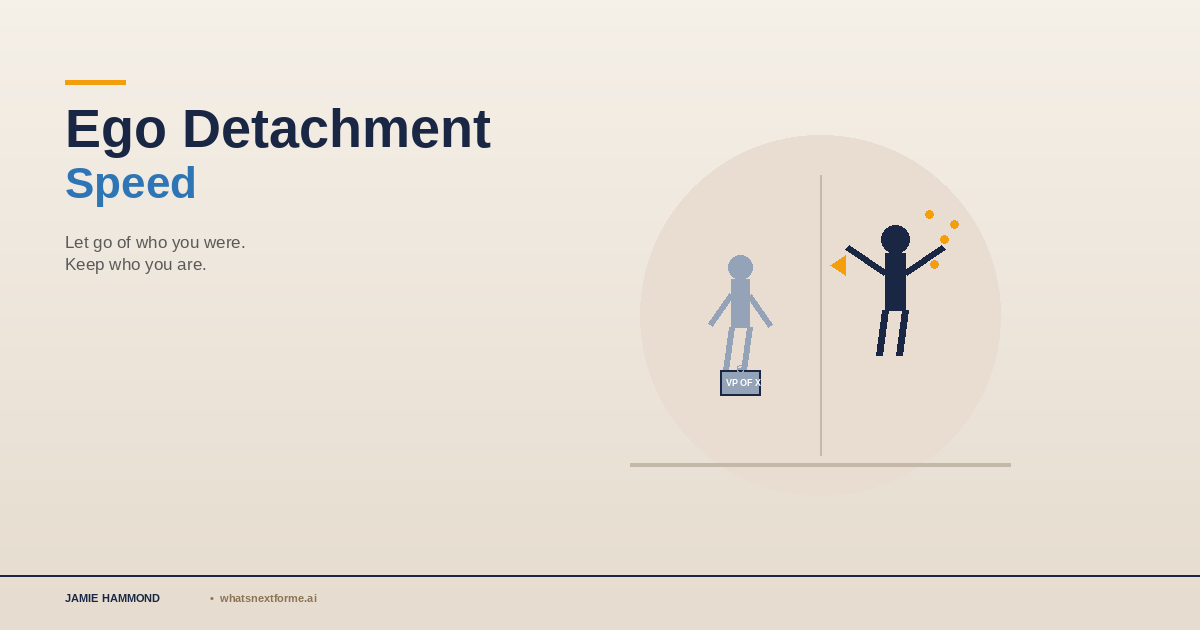
The line I keep coming back to is this: you can let go of who you were without losing who you are.
That distinction makes worlds of difference. The former identity, the title, the expertise, and the specific role, is not the same as the underlying judgment, pattern recognition, and way of thinking you’ve accumulated over years. One expires, but the other can travel. Ego detachment is the ability to tell the difference quickly and act on it.
Why Speed Is the Variable
Everyone eventually adapts. Given enough time and enough pressure, most professionals do find their way to the next version of themselves.
The question is how long it takes, and let’s not kid ourselves; there is a real cost to delay.
The months spent defensively positioning instead of genuinely learning. The opportunities that went to someone who entered the new terrain faster and without the resistance. The reputational calculus that shifts, subtly and without announcement, when the people around you start to see you as rigid where they used to see you as confident. The cynicism that develops as a protective layer around an identity that isn’t quite ready to change, which makes you genuinely harder to work with in the process.
Slow ego detachment is both uncomfortable and expensive.
The difference between graceful evolution and reluctant compliance is largely a function of how quickly you can move through that gap: the space between who you were and who the moment requires. Graceful evolution happens when the release comes before the external pressure forces it. Reluctant compliance happens when you held on too long and the circumstances made the decision for you.
Both get you to the other side, but only one keeps your authority intact on the way there.
Three Markers of Slow Detachment
These are patterns, signals that the ego is working to protect a former identity in ways that are starting to cost more than they’re preserving.
Over-defending past expertise. The tell is when context shifts and the response is to relitigate why the old approach was right rather than genuinely engage with what’s different now. It’s a subtle move, often framed as rigor or experience, but underneath it is a refusal to let the former expert status become contingent.
Dismissing new tools reflexively. Healthy skepticism about technology is legitimate and valuable. Pattern Authority, as I wrote about earlier in this series, is precisely the ability to evaluate new tools with calibrated judgment rather than hype. But there’s a meaningful difference between calibrated skepticism and reflexive dismissal, and reflexive dismissal usually isn’t about the tool as much as it’s about what the tool’s implications are for the shelf life of existing expertise.
Over-indexing on credentials for reassurance. When the external environment feels destabilizing, credentials become a kind of comfort mechanism, a way for the ego to assert continued relevance through documentation. More certifications; more courses; more badges. Unfortunately, these aren’t used because they’re building genuine new capability, but because they’re providing the feeling of forward motion without requiring the ego to actually change.
The contrast between slow and fast detachment is pretty hard to mistake once you know what to look for. The fast-detachers are curious and not insecure; they’re calm in the gap they’re facing, but seek actively to close it. Instead of learning from a place of anxiety, they learn new things because they’re “on their way” to this new phase of their career.
What Letting Go Actually Felt Like
When I was transitioned out of the consulting firm, I couldn’t ignore the income disruption of course, but it wasn’t the hard part.
The hard part was the morning I sat down to write a proposal for a potential client, independently, for the first time, without the firm’s name at the top of the document, and felt genuinely uncertain of whether what I had to offer was enough on its own.
The identity I’d worn for years had been partly mine and partly borrowed from the institution. The brand, the methodology, the implied authority of the letterhead, more of that had been load-bearing than I’d let myself acknowledge while it was still there.
Letting it go required being honest about that. Which required sitting in a version of “temporarily unimpressive”, at least in my own head, for longer than was comfortable.
What I had to release: the assumption that the credential and the context would do the work that my thinking should have been doing on its own.
What I found on the other side: that the thinking actually held up. That the pattern recognition was real. That clients would pay for the judgment independent of the container it used to live in.
But I couldn’t find that out without going through the gap. There was no shortcut around it. The only way was through, which meant releasing before I had certainty about what was on the other side.
That’s what ego detachment actually requires: the willingness to move through the gap before the destination is fully visible (dealing well with ambiguity, the ultimate consulting barometer!).
We’ve covered five disciplines in this series.
Identity Optionality gives you the structure: the portable value that doesn’t expire with any single role. Reframing Before Reskilling gives you the leverage: the ability to translate what you already know into new terrain. Pattern Authority gives you the edge: the compounding judgment that comes from surviving multiple cycles. AI as Exposure Layer gives you the clarity: an honest read on where your value is genuinely durable and where it needs strengthening.
Fast Ego Detachment gives you the velocity.
And in an era where the pace of change is compressing adaptation timelines, velocity compounds on itself. The professional who can release a former identity in weeks rather than years adapts faster, arrives earlier, builds credibility sooner, and positions themselves for the next transition before most people have finished processing the current one.
The question was never whether you’ll need to begin again: you will. That’s settled at this point.
The question is how long you’ll resist before you do, and what that resistance costs you while you’re holding on.
The Repeat Beginner doesn’t wait for certainty. They begin again, with their memories intact, before the gap they need to close becomes much, much wider.